What Is Cannibalization in SEO? Detecting, Fixing, and Preventing Overlapping Pages
Learn what SEO cannibalization is, how to detect it in Search Console, and how to merge, retarget, or canonicalize overlapping pages.

Your product team publishes a new guide targeting a valuable topic. A few weeks later, traffic is flat. Search Console shows impressions, but clicks are spread across an old blog post, a newer comparison page, and a product landing page. None consistently owns the query.
That situation leads founders to ask, what is cannibalization, and whether Google is penalizing the site. Usually, there's no penalty. The operational problem is that several URLs address the same search need, so your team hasn't made the preferred result clear.
For a lean B2B SaaS team, this matters because every overlapping page consumes writing, design, development, and internal-linking effort. The fix rarely requires a large SEO project. You can find the overlap in Google Search Console, decide which URL deserves the intent, ship a consolidation or redirect, and monitor the result in the same tools you already use.
Introduction to Cannibalization in SEO
A founder notices that a core product term has stopped moving. The team has published consistently, refreshed old content, and added internal links. Yet Search Console shows the same query sending impressions to several URLs. One page ranks on some days, another appears later, and the commercial landing page receives little of the available attention.
That's a practical example of SEO cannibalization. The pages aren't necessarily broken, blocked, or technically invalid. They're competing for the same audience and search intent, which can spread impressions, clicks, and relevance signals across URLs instead of concentrating them on the page that best supports the business.
The warning signs are usually visible:
- One query, several URLs: The Pages report shows multiple pages receiving impressions for the same search.
- Unstable ownership: Different URLs appear to take turns ranking for the query.
- Weak commercial alignment: An informational article ranks when a product or use-case page would better convert the visitor.
- Flat output from new work: Publishing more content doesn't produce a clear increase in clicks for the topic.
This isn't a reason to delete pages automatically. Multiple URLs can rank without causing harm. The question is whether the overlap reduces clicks, weakens the preferred page, or sends visitors to the wrong stage of the buying journey.
Understanding the Key Concepts
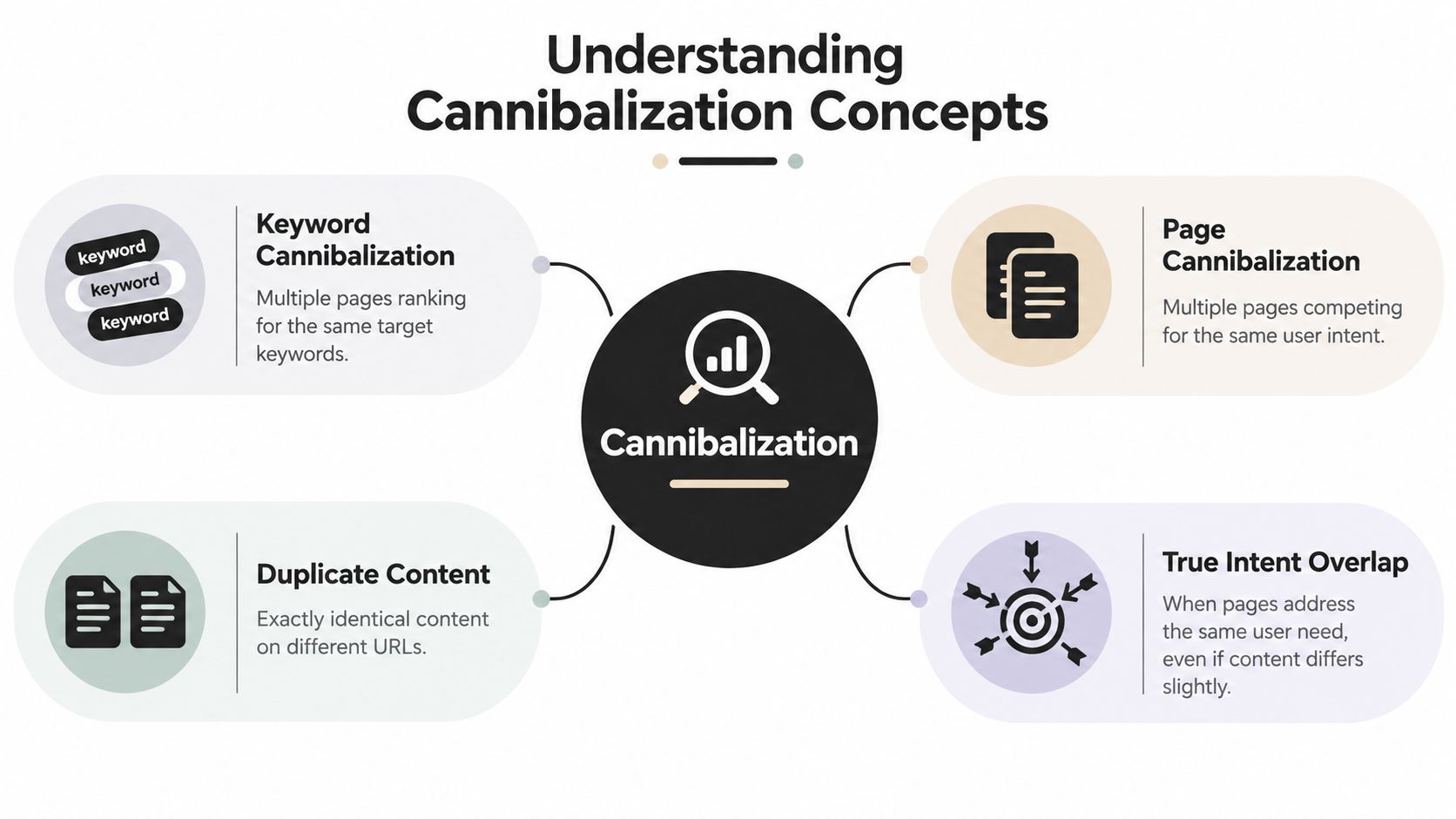
Keyword cannibalization is a diagnostic condition where two or more pages on the same site compete for the same query and search intent. Search Console may show one query mapping to several URLs with real impressions and middling average positions, a pattern that can split impressions and authority instead of concentrating signals on one primary page. QueryScope's Search Console explanation describes this diagnostic approach.
Page cannibalization is the broader site-structure problem. The pages may use different wording, titles, or formats, but they still compete to satisfy the same user need. For example, a B2B SaaS site might have:
- A blog post explaining "workflow automation"
- A product page targeting "workflow automation software"
- A webinar page titled around "how to automate workflows"
If all three primarily answer "Which workflow automation solution should I evaluate?", the format difference doesn't create meaningful intent separation.
Duplicate content is narrower. Two URLs might contain substantially identical text, such as a parameterized version of a product page and its clean URL. True intent overlap can exist even when the copy differs. That distinction determines the fix. Duplicate or near-duplicate URLs may need canonical consolidation, while separate pages with the same intent may need merging, retargeting, or a clearer site hierarchy.
A useful mental model comes from portfolio planning. James Heskett's 1976 definition described cannibalization as "the process by which a new product gains sales by diverting sales from an existing product." Later research broadened the idea to demand shifted within the same company's portfolio, and by 1994, Reddy et al. had formalized it as a measurable share of new-product sales coming from existing products. The academic history and measurement framework explains why gross growth doesn't always equal net-new demand.
SEO uses the same logic. A new page can gain impressions while taking visibility from an existing page. The question is not merely whether the site grew. It's whether the new URL created additional search coverage or redistributed the same opportunity.
A keyword map, such as the workflow described in Orchory's keyword clustering guide, helps assign one primary intent to each URL. Teams can also use the Orchory AI Keyword Research Tool when organizing research before creating or updating pages.
Detecting Cannibalization in GSC and Analytics
Start with Search Console, not a rank tracker. Search Console shows which queries generated impressions and which URLs received them, so it gives you the evidence needed to distinguish ordinary ranking variation from real overlap.
Build a useful data set first
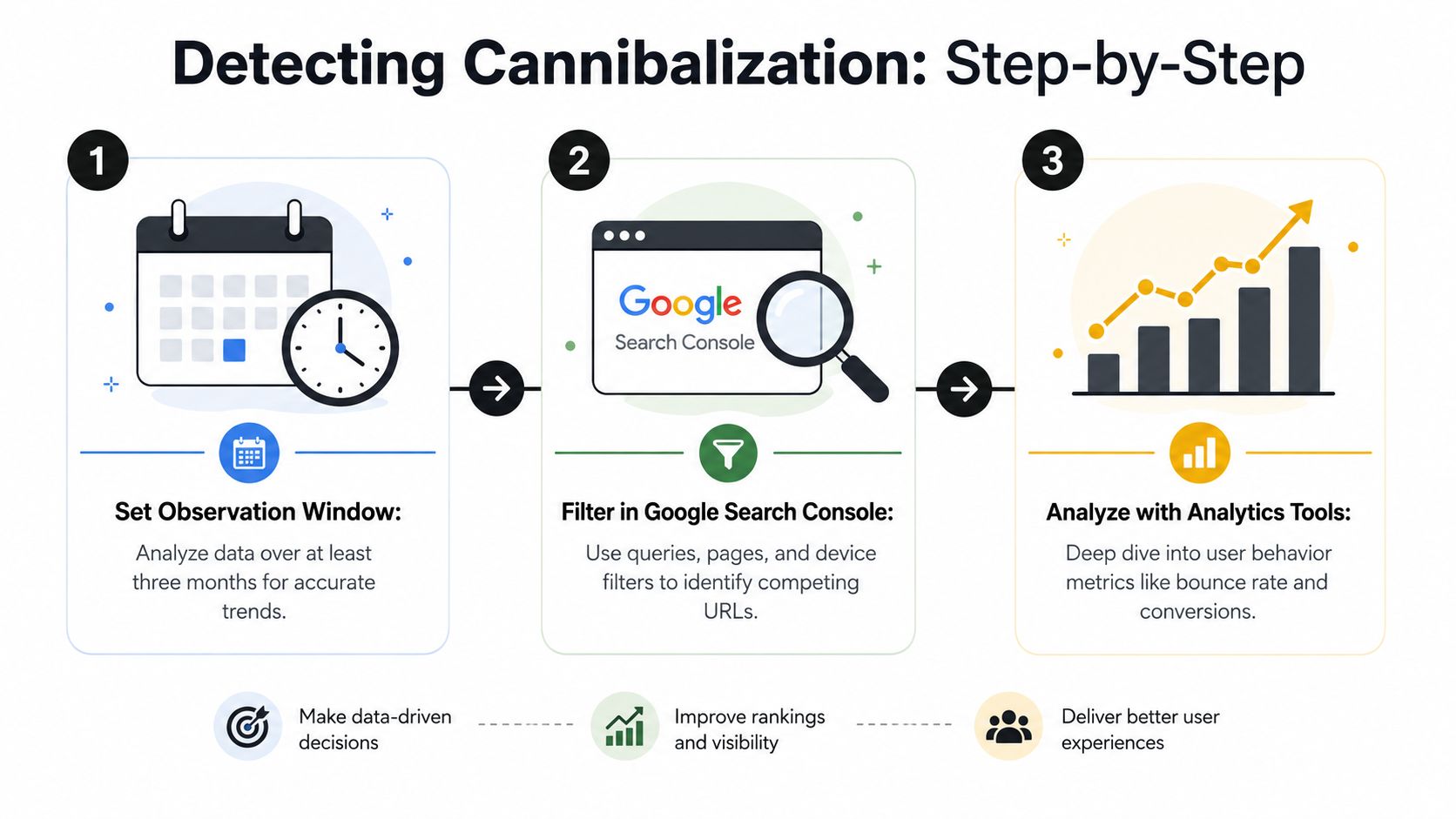
Use an observation window of at least three months and focus on queries with meaningful volume, often 100+ monthly impressions, so temporary fluctuations don't dominate the review. These thresholds come from the practical workflow documented by Analyseo's Search Console guide.
Then follow this sequence:
- Export the Search results report. Include query, page, clicks, impressions, click-through rate, and average position. Exporting lets you group rows by query instead of inspecting URLs one at a time.
- Group by query. Find queries associated with two or more URLs. Don't stop at matching words. Read the query and inspect each page's purpose.
- Check comparable activity. Two URLs with meaningful, comparable impressions deserve attention. One dominant URL and one marginal URL usually reflects normal long-tail variation.
- Inspect the Pages tab. Filter Search Console by the query, then open Pages. Record which URL receives impressions, clicks, and the stronger average position.
- Compare analytics outcomes. In your analytics tool, compare organic entrances, engaged sessions, signups, demo requests, and assisted conversions for the competing URLs. A page with fewer clicks may still be the better commercial asset, while a high-traffic article may send visitors nowhere useful.
- Prioritize by business risk. Start with overlap involving product, comparison, integration, pricing, or use-case pages. Then review high-impression informational clusters.
The table below gives a compact triage model.
| Signal | Threshold | Recommended Action |
|---|---|---|
| Same query maps to multiple URLs | Two or more URLs with real impressions | Inspect intent and select a preferred page |
| Query has enough historical data | At least three months | Avoid decisions based on short-term noise |
| Query has meaningful demand | Often 100+ monthly impressions | Prioritize the overlap over low-volume anomalies |
| One URL dominates activity | One clear leader, another marginal | Usually monitor rather than consolidate immediately |
| Similar URLs have comparable activity | Comparable impressions or clicks | Test merge, retargeting, or stronger internal linking |
Place the visual workflow near the data review so a developer can follow the same sequence during a sprint.
For a hands-on walkthrough of the reporting workflow, use this video after exporting the query and page data.
<iframe width="100%" style="aspect-ratio: 16 / 9;" src="https://www.youtube.com/embed/n3jrXrau6kE" frameborder="0" allow="autoplay; encrypted-media" allowfullscreen></iframe>Practical rule: Don't call cannibalization from a keyword list alone. Confirm shared intent, comparable activity, and a business reason to prefer one URL.
Real World Examples of Cannibalization
Consider a product-led SaaS site with two landing pages, one for a general product category and one for a closely related use case. Both pages appear for the same commercial query. Together, they receive 1,200 monthly impressions, but the site records 30 fewer clicks than its previous baseline because neither page consistently ranks above position 5. Those figures describe the assigned scenario, not a published case study, so treat them as a diagnostic example rather than a benchmark.
The team compares page titles, headings, conversion paths, and Search Console data. Both pages promise the same core solution, and neither has a distinct audience or job to be done. The team keeps the URL with stronger links and clearer product alignment, moves the unique use-case material into that page, redirects the weaker URL, and updates internal links. The correct success test is whether the preferred page captures a clearer share of the query and whether organic conversions improve, not whether every old URL remains indexed.
A second pattern appears when a blog post and webinar landing page target the same topic. The article earns informational impressions, while the webinar page contains the registration form. If both pages compete for the same query, Search Console may split visibility and analytics may divide conversion signals between an educational URL and an event URL. The solution could be consolidation, or it could be intent separation. The article can own the explanatory query, while the webinar page targets an event-specific query and receives a prominent contextual link.
Overlap becomes more likely as a site ages and accumulates content. A 2025 analysis of 1,500 websites reported duplicate-keyword overlap rising from 2.19% for sites under 1 year old to 13.95% for sites older than 10 years. A separate 2026 study found an average of 4.7 URLs ranking for each top keyword and 68% of sites showing significant cannibalization. The reported site-level analysis supports treating overlap as an operational issue that grows with content volume.
Business Impact of Cannibalization
Cannibalization affects the business when the wrong URL wins or when several URLs divide the same opportunity. An informational article might attract the impression while the product page has the stronger signup path. A comparison page might rank for a broad category query while the dedicated integration page has the evidence needed by a buyer. In both cases, traffic can exist without producing the intended pipeline.
SEO teams also misread gross performance. The academic and marketing research history treats cannibalization as demand shifted within a company's portfolio, not automatically as failure. A new page can gain visibility while an older page loses visibility, leaving total demand mostly redistributed. That's why compare the combined clicks, organic entrances, and conversions for the URL group, not only the new page's individual report.
Decide whether the overlap is harmful
There is no cannibalization penalty, and multiple pages ranking for one query isn't necessarily a problem, according to Valve and Meter's guidance on the issue. Keep multiple pages when they serve clearly different intents, audiences, or stages of evaluation.
Act when the data shows one of these conditions:
- The wrong page attracts the query: A blog post ranks where a product page should answer a commercial need.
- The URLs trade positions: Search Console or a rank history shows unstable ownership between pages.
- The same visitors enter different URLs: Analytics reveals duplicated acquisition paths with no distinct conversion role.
- The pages share a primary job: Readers would reasonably expect the same answer from both URLs.
- The team maintains both without a reason: Content and engineering time goes into preserving two pages that serve one purpose.
Don't invent a conversion-rate assumption to justify a merge. Use your actual organic conversion rate for the affected page group, then model the potential outcome as a scenario. If a query group currently produces a known number of clicks and your analytics shows a known signup rate, calculate the gap using those observed values. If the data is too thin, label the opportunity qualitatively and ship the lowest-risk structural fix first.
Cannibalization is harmful when it makes your site less clear to searchers or less useful to the business. It isn't harmful merely because more than one URL appears in Google.
Remediation Strategies to Fix Cannibalization
Choose the fix based on intent, not on which URL has the prettier design. First select the preferred URL using evidence such as relevant impressions, clicks, links, organic conversions, content depth, and fit with the commercial journey. Then record that decision in your content map so the next writer or developer doesn't recreate the conflict.

Merge when one intent deserves one answer
Merge pages when they answer the same question and the stronger result can absorb the useful material from both. Preserve unique examples, product details, objections, and supporting evidence. Rewrite the introduction, title, headings, and calls to action so the final page has one clear purpose.
Then execute the technical cleanup:
- Publish the consolidated page at the preferred URL.
- Add a 301 redirect from each redundant URL to that destination.
- Update internal links, navigation, related-content modules, and campaign references.
- Remove redirected URLs from the XML sitemap.
- Check that the destination returns a successful response and that no redirect chain exists.
- Re-export Search Console data after the change and compare the URL group against its earlier baseline.
That sequence matches the standard consolidation approach described in Semrush's cannibalization guide. A redirect without content consolidation leaves the destination weak. Content consolidation without internal-link updates leaves your own site sending mixed signals.
Retarget when both pages have separate jobs
If the pages serve different audiences, change the secondary page's scope. A product page can target solution evaluation, while a blog post targets implementation guidance. Remove the overlapping primary language from the secondary page, revise its title and headings, and link it to the preferred commercial page with descriptive anchor text. Use the principles in this internal linking strategy guide to make the relationship explicit.
Use canonicals only for close duplicates
A canonical tag can consolidate duplicate or near-duplicate URLs, but it isn't a universal response to different pages with overlapping intent. Google's guidance distinguishes canonical signals from broader competition between URLs. Google's Search Console discussion of canonical and cannibalization issues is useful when deciding whether pages are duplicates.
For a coding agent, write an implementation prompt with the exact source URLs, destination URL, content sections to preserve, internal links to update, sitemap files to edit, and acceptance checks. Orchory can generate prompts for coding agents to open pull requests containing redirect rules and updated page content. Keep review and merge under your team's control.
Monitoring and Preventing Future Cannibalization
A one-time cleanup won't protect a growing SaaS site. New feature pages, integration pages, glossary entries, and content refreshes can recreate overlap unless someone checks the topic map before publication.
Use a lightweight operating rhythm:
- Weekly GSC audits: Export query and page data, group by query, and flag new cases where multiple URLs receive meaningful impressions.
- Custom analytics filters: Create views for organic entrances, signups, demo requests, and assisted conversions by landing-page group. This reveals when the wrong URL captures demand.
- Content approval checks: Require every new page brief to name one primary intent, one preferred URL, and the existing pages reviewed before publication.
- Quarterly content reviews: Revisit major topic clusters, especially after product launches, migrations, or large content pushes.
- Post-release checks: Review Search Console after a new page has accumulated enough data. If it begins appearing for an existing page's core query, retarget it before the overlap expands.
Keep a shared record with the URL, primary query, search intent, page type, preferred destination, and current status. When someone proposes a new page, search that record before development starts. If an existing URL already owns the intent, expand it or choose a narrower supporting intent instead of publishing a near-duplicate.
Orchory's pipeline can support this process by refreshing keyword clusters and opportunity queues, while the final page changes remain pull requests for review. That makes cannibalization prevention part of shipping discipline, not a separate report that nobody acts on.
Conclusion
Cannibalization occurs when multiple URLs compete for the same query and user intent. It isn't a Google penalty, but it can send impressions and clicks to the wrong page, split your internal signals, and waste content and development effort.
Start with at least three months of Search Console data. Filter meaningful queries, inspect the Pages tab, compare organic conversions, and prioritize URL pairs with shared intent and comparable activity. Merge pages when one answer should serve the query, retarget them when their jobs differ, and use canonicals only for genuine duplicates.
Put the check into every content brief and sprint review. Run an initial audit, create a preferred-URL list, ship the highest-value consolidation first, and schedule recurring reviews. Use Orchory to keep keyword opportunities and page intent organized as the site grows.
Orchory maps keywords into clusters, scores page opportunities, and produces ready-to-run prompts that coding agents can use to open pull requests, so your team can turn cannibalization findings into reviewed changes. Visit Orchory to organize the next audit and keep new SEO work aligned with the pages you already want to rank.
FAQs
What is cannibalization in SEO?
Is there a Google penalty for keyword cannibalization?
How do I detect cannibalization in Search Console?
Should I merge, retarget, or use a canonical to fix overlapping pages?
How do I prevent cannibalization as my site grows?